For a decade, glamping was sold as a solo act. One bell tent, one couple, two nights, one photograph. The product was novelty, and novelty priced well precisely because it was small.
That guest still exists. But they are no longer the guest who determines whether a park is profitable.
The bookings that now fill shoulder seasons and lift average stay length come from parties that cannot fit in a single-room unit: two couples travelling together, a family with school-age children, three generations sharing a long weekend, a remote-working pair who need a bedroom that is not also the office. These groups are not looking for a novelty. They are looking for a home they can borrow for four nights — with a real bathroom, a real kitchen, a door that closes between the children and the adults, and heating that works in October.
That is a different building. And for most operators, it is the building they do not have.
The 2026 opportunity in glamping and rural hospitality is not more units. It is the right mix of one-, two-, and three-bedroom units — and a construction method that can deliver them before the season they were financed for.
Group and multigenerational trips concentrate demand into units that sleep four to six people in separated rooms. A park composed entirely of single-room units cannot accept this booking at all — it either splits the party across units, which most groups decline, or turns the enquiry away.
A two-night guest tolerates a suitcase on the floor. A five-night guest needs a wardrobe, a full kitchen, a washing line, and somewhere to put wet boots. Length of stay is the single most powerful lever on operating margin, and it is a function of how liveable the unit is — not how photogenic.
A park that trades fourteen weeks a year is a hobby. A park that trades year-round is an asset. Off-season trading requires genuine thermal performance, not canvas: insulated envelopes, efficient heating, and units certified for winter occupancy.
Once a unit has three bedrooms and a kitchen, its competitor is a serviced apartment or a rural hotel suite — a category with far higher willingness to pay. The larger unit is not simply a bigger version of the small one. It moves the whole property into a different pricing bracket.
This is where most feasibility studies go wrong in one direction or the other. Enthusiasts claim large units are simply better. Sceptics point out that revenue per square metre falls as units get bigger. Both are looking at one number.
We modelled a twelve-unit mixed park to show what actually happens. The assumptions below are editorial illustrations for the purpose of explaining the mechanism, not InstaBuilt quotations or projections: six one-bedroom units at €130 per night and 52% annual occupancy; four two-bedroom units at €205 and 57%; two three-bedroom units at €300 and 61%; average stays of 2.1, 3.4, and 4.2 nights respectively.
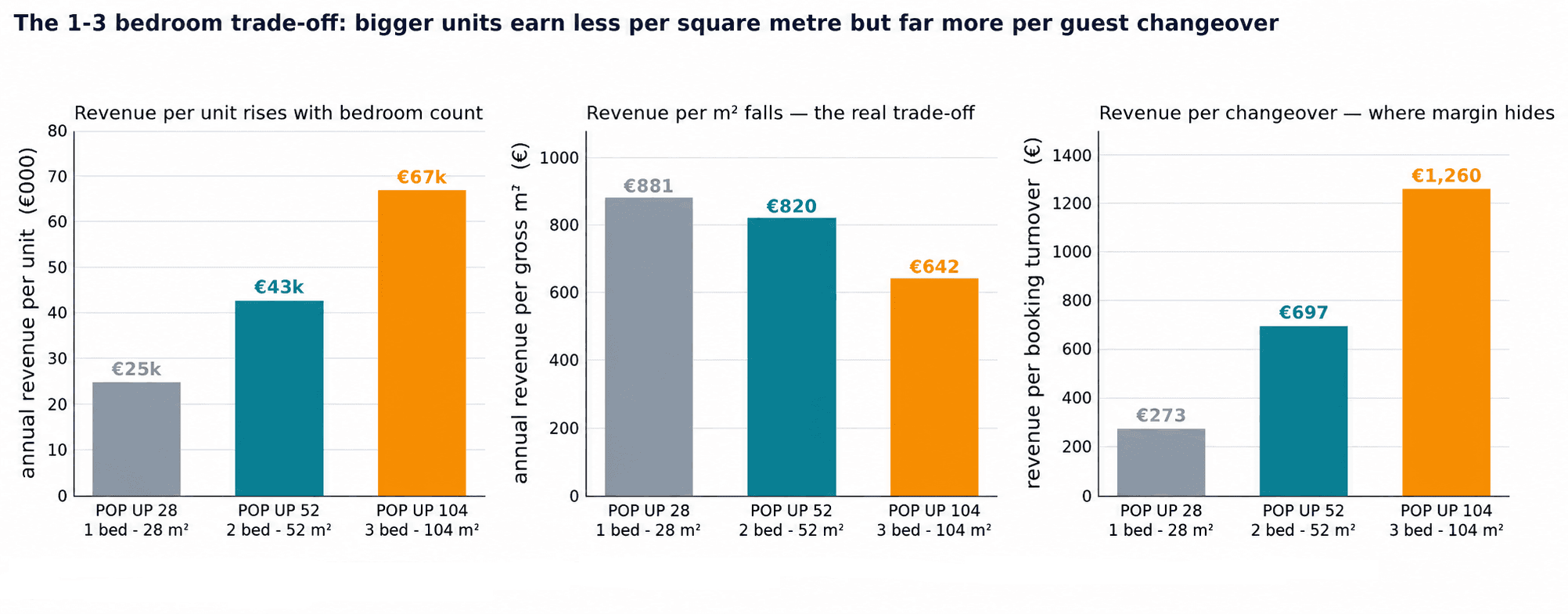
Three findings, and the third is the one that matters.
Revenue per unit rises steeply. A three-bedroom unit generates roughly €66,800 a year in this model, against €24,700 for a one-bedroom — about 2.7 times the revenue from 3.7 times the floor area.
Revenue per square metre falls. €881/m² for the one-bedroom against €642/m² for the three-bedroom. If your only constraint were land, small units would win. This is the honest counter-argument, and it is real.
But revenue per changeover rises 4.6× — €1,260 for the three-bedroom against €273 for the one-bedroom. This is the number that decides whether a park is operable.
Every booking, regardless of unit size, triggers a fixed bundle of cost and friction: a clean, a linen change, a check-in, a consumables restock, a review to manage, a payment to reconcile. In this model the one-bedroom unit generates about 90 changeovers a year; the three-bedroom generates 53. The larger unit produces two and a half times the revenue while creating thirty-seven fewer operational events.
Small units sell square metres. Larger units sell nights — and nights are what a lean operating team can actually service.
The composite result: in this illustrative park, the two- and three-bedroom units account for 67% of annual revenue from 50% of the units. That is the sentence worth taking into a lender meeting.
The strategic conclusion is a mix, not a monoculture. One-bedroom units remain the best instrument for capturing couples midweek, filling gaps, and holding a low entry price point in the listing. Two- and three-bedroom units carry the revenue and the shoulder season. A park designed around only one of these is leaving money on the table in one direction or the other.
Here is the problem every operator who has run these numbers already knows: the demand analysis points at larger, better-insulated, year-round units — and larger units built conventionally are exactly what a seasonal hospitality business cannot afford to wait for.
A conventionally built three-bedroom unit is a twelve-month site programme. Twelve months means at least one winter, one full weather-risk cycle, a sequential trade chain in which every crew waits for the one before it, and — critically — an entire trading season missed between the moment capital is committed and the moment the first guest checks in. For a business whose revenue is concentrated in a handful of months, a schedule slip is not an inconvenience. It is a year.
This is what industrialized construction changes, and it changes it in a specific way that is worth being precise about. It is not that the work is done faster by rushing. It is that the work is re-sequenced so that most of it stops being site work at all.
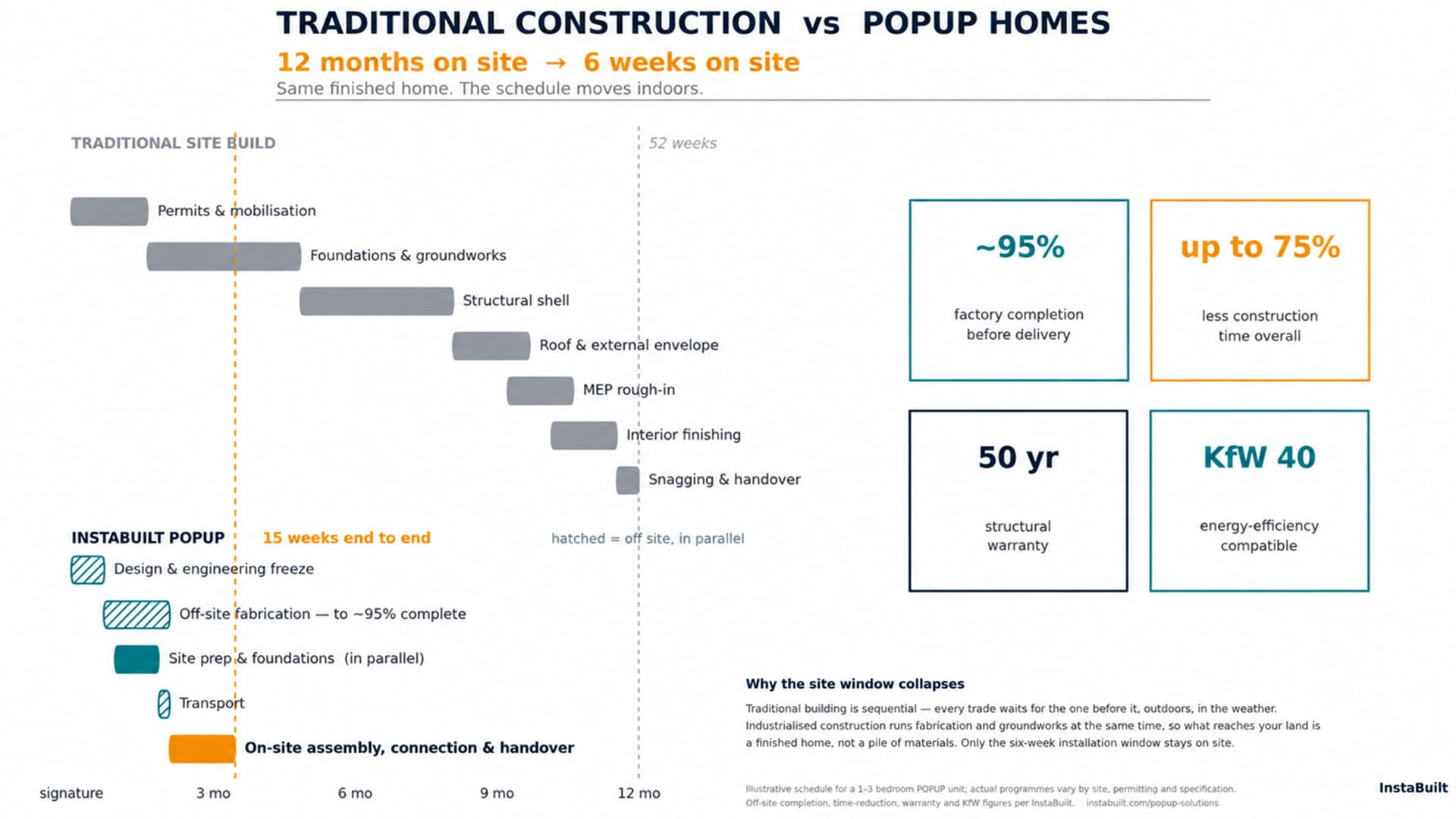
Figure 2 — Traditional construction versus POPUP homes: 12 months on site against a six-week installation window.
In InstaBuilt's volumetric modular system, units reach approximately 95% completion in the factory before they are delivered — insulation, interior finishes, electrical and plumbing systems, bathrooms, windows, flooring, roofing, and external façades already installed. While those modules are being manufactured indoors under quality control, groundworks and site preparation proceed in parallel on the land. The two critical paths run at the same time instead of one after the other.
What arrives on site is a finished home, not a delivery of materials. Only the installation window remains — and across its systems InstaBuilt reports construction-time reductions of up to 75% compared with conventional methods, depending on the project.
For a hospitality operator, that difference is not an engineering detail. It is the difference between opening this season and opening next.
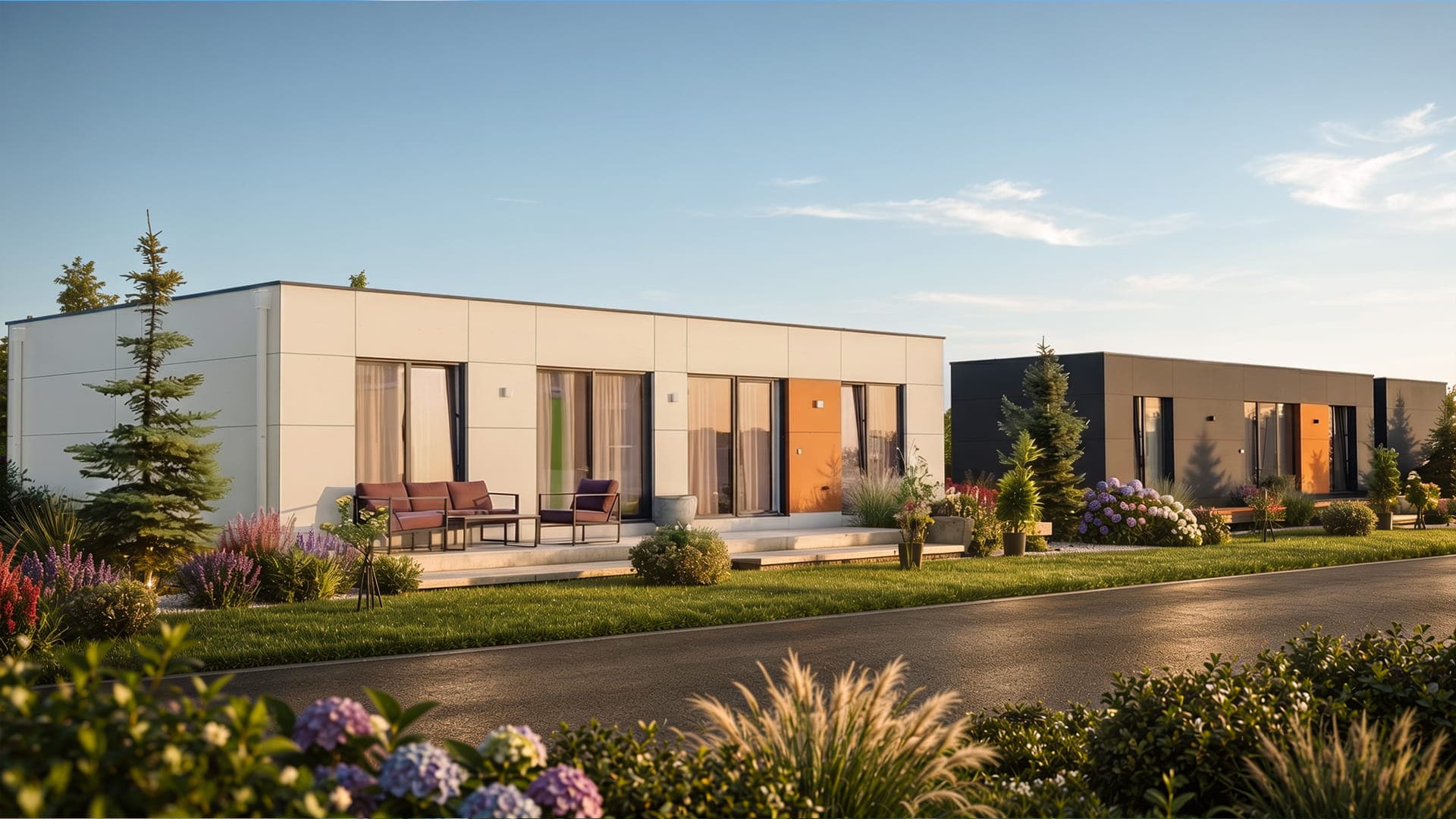
InstaBuilt's POP UP line maps directly onto the mix the 2026 demand picture calls for:
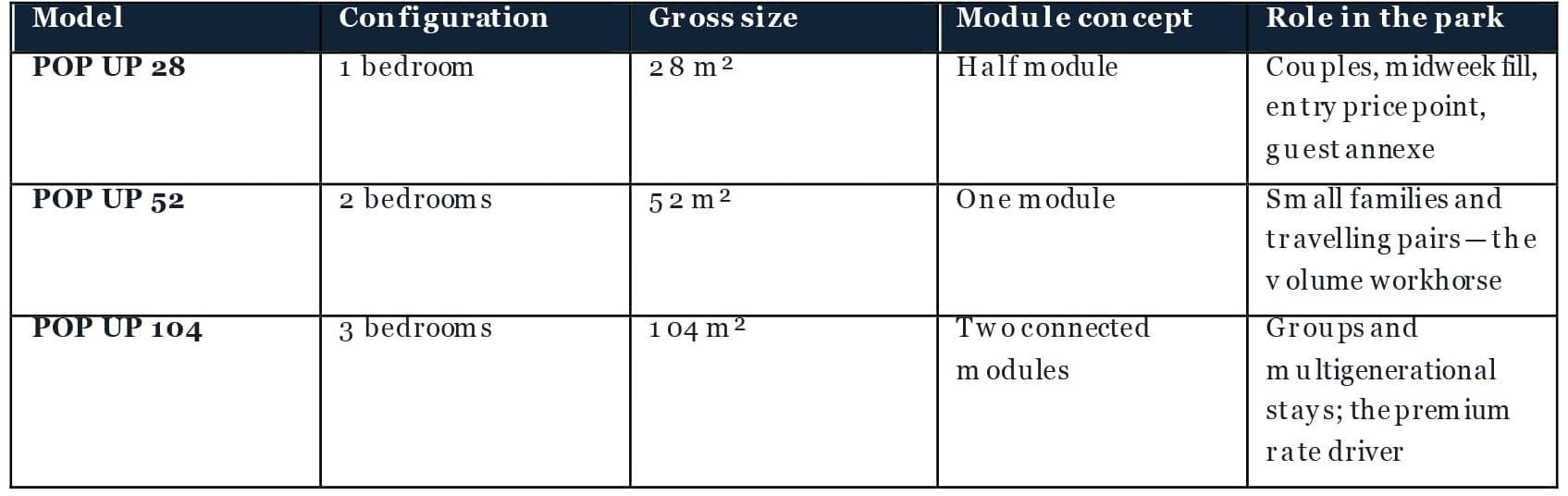
All three are designed for year-round use, which is the precondition for off-season trading, and are delivered with high-performance insulation and finished interiors as standard. Optional specifications extend the hospitality proposition directly: kitchens, terraces, air conditioning, solar systems, steel foundations, saunas, and jacuzzis — the last two being among the most reliable premium-rate justifications in rural accommodation.
The system carries a structural warranty of up to 50 years, with separate warranties applying to concealed and visible elements, and is built to KfW 40-compatible energy-efficiency standards — relevant both to operating costs and to financing conversations in Germany and the wider DACH market.
Because all three models derive from the same panelized and volumetric platform, the mix is a commercial decision rather than an engineering one. A park can open with a phase-one cluster, observe which configuration actually books in its own micro-market, and add the next phase against evidence instead of assumption — using the same production system, the same detailing, and the same warranty.
If you are holding land and evaluating this, the sequence that separates a strong project from an expensive one:
Confirm what your planning authority permits for year-round versus seasonal occupancy — this single answer can invalidate an entire business plan, and it should be established before any unit is specified.
Identify your actual booking market, then let it set the mix. A ski-adjacent valley, a coastal site, and a city-fringe location produce genuinely different optimal ratios of 28/52/104.
Model revenue per changeover, not only revenue per square metre — and staff the park against the changeover count your mix implies.
Check site access for module delivery early: crane positioning and transport routing shape which configurations are even feasible on your land.
Phase the development, and let phase one generate the occupancy data that sizes phase two.
Build the financing timeline around the construction timeline. A six-week installation window and a twelve-month site programme are different businesses.
The demand signal for 2026 is not ambiguous: parties are getting larger, stays are getting longer, and the operating season is stretching toward the full year. The units that serve that guest are 1–3 bedroom homes with real thermal performance — and the operators who capture it will be the ones whose buildings arrive in weeks rather than seasons.
Whether you are assessing a single unit or planning a phased park, the first step is establishing what your land, your market, and your permissions will support.
Product specifications, off-site completion percentages, construction-time reduction, structural warranty, and KfW 40 compatibility are as stated by InstaBuilt. The twelve-unit revenue model is an illustrative editorial scenario built to demonstrate the relationship between unit size, revenue per square metre, and revenue per changeover; the ADR, occupancy, and length-of-stay inputs are assumptions, not InstaBuilt quotations, forecasts, or guarantees of return. Actual project performance depends on location, permissions, site conditions, specification, financing, operating costs, and management. Construction programmes vary by site and permitting regime.